Duct bank under Cooper Street retail pad
Post-paving TI on Cooper cannot trench across drive aisles during event season. HDD links vaults under asphalt with pits staged for night windows when game-week traffic compresses the work calendar.
Arlington, TX · Tarrant County
Steerable HDD through mid-cities clay, Woodbine sandstone, and entertainment-district traffic — Arlington directional drilling with event-calendar MOT and Lake Arlington groundwater planning.
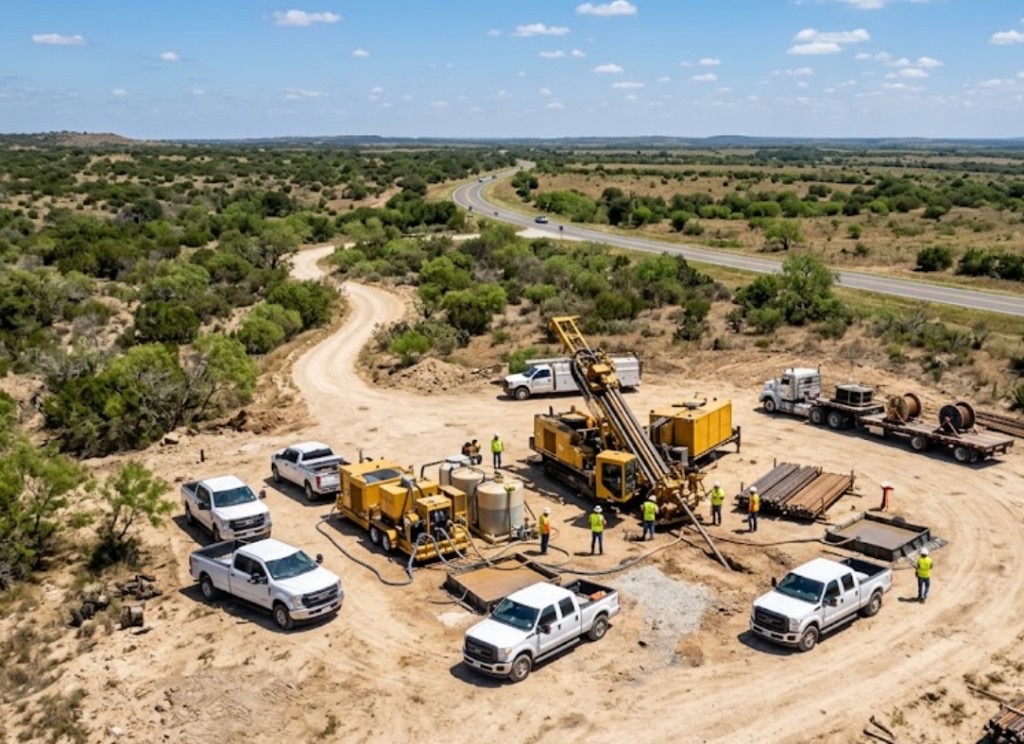
Horizontal directional drilling in Arlington balances AT&T Stadium corridor traffic, UT Arlington campus adjacency, and Woodbine sandstone with blackland clay along Cooper Street, Division, and south Arlington subdivisions. Homeowners near Randol Mill save lawns when sewers fail; retail GCs bore duct under parking without losing game-week access.
Arlington sits between Dallas and Fort Worth with geology and traffic patterns neither city owns entirely. Directional Boring Texas tickets Texas 811, coordinates city event traffic plans near Globe Life Field, and quotes TxDOT lead time on I-20 and SH-360 relocations before pits open.
Real Tarrant County angles — not generic statewide copy.
Post-paving TI on Cooper cannot trench across drive aisles during event season. HDD links vaults under asphalt with pits staged for night windows when game-week traffic compresses the work calendar.
Higher groundwater near the lake affects pit stability and HDPE pullback buoyancy. Steerable bore from cleanout to Arlington Water Utilities tap preserves the yard — dewatering planned before mobilization.
TxDOT relocations stack under state ROW at Arlington's edge. HDD narrows closure footprint — MOT plans scoped before rig booking.
Campus corridor utilities need bores under paved quadrangles and chilled-water easements. Access coordination with facilities staff quoted in scope — not sprung on drill day.
Arlington crews walk alignment with Oncor and Arlington Water Utilities maps. Entry pits account for mid-cities clay and sandstone stringers; mud programs manage frac-out risk toward storm drains. Near Lake Arlington, pullback buoyancy is monitored. Event-district jobs schedule around major venue calendars.
Woodbine sandstone and clay mixes typical of the Mid-Cities — shallower rock than east Dallas, variable groundwater near Trinity tributaries.
Arlington profiles blend clay with Woodbine sandstone stringers. Sandstone can stabilize bores but increase tool wear. Near Trinity tributaries, groundwater rises and softens entries. Caliche pockets appear inconsistently — neighbor history and test pits inform ream sizing. Mid-Cities ground is not identical to Fort Worth or Dallas; we scope accordingly.
Metroplex thunderstorms and hail affect Arlington street work; Globe Life Field and entertainment events add traffic control complexity.
Hail season can delay restoration. Summer heat limits asphalt work near black stadium pavement. Event weekends compress allowable lane closures — schedule discipline matters more here than in quieter suburbs.
City of Arlington Public Works, Tarrant County pockets, TxDOT Arlington-adjacent routes, and event-district traffic plans near AT&T Way.
City of Arlington Public Works permits ROW and bore notifications. Entertainment District work may need event coordination with city traffic management. TxDOT permits apply on I-20 and state highways. Pantego and Dalworthington Gardens have separate municipalities with their own ROW contacts on some streets.
Open-cut through entertainment corridor paving and south Arlington lawns destroys access and turf faster than the bore costs. HDD wins on developed lots and post-paving TI.
Length, diameter, soil/rock, groundwater, traffic control, permit fees, number of utilities in corridor, night work, and rig class drive estimates — not a single per-foot rate.
We review plans, bore path, access, existing utilities, and owner goals — residential repair or engineered crossing.
Texas dig law compliance: ticket, wait period, verify marks, pothole at conflicts before steel or bit enters ground.
Alignment, profile, soil expectations, permit needs, and crossing agreements for roads, rails, or waterways.
Right rig for length and diameter — mini-HDD for tight urban shots, larger spreads for long pulls and reams.
Steerable pilot, survey checks, reaming passes as required for product pipe or casing diameter.
HDPE fusion, steel casing, conduit bundles, or carrier pipe installed per spec with pullback monitoring.
Alignment records, mandrel or pressure tests where spec requires, as-built for owners and inspectors.
Minimal surface disturbance philosophy — compact entry/exit pits, restore hardscape and landscape per scope.
Length, sandstone intervals, event MOT, lake-adjacent dewatering, TxDOT permits, and restoration drive estimates — not a flat per-foot rate.
More Woodbine sandstone influence and variable groundwater near creeks. Ream time and mud program differ from pure blackland assumptions.
Yes with city traffic plans and event-calendar coordination. Some work only fits off-peak windows.
Yes — including separate municipal ROW contacts where those cities control the street.
Curved alignments favor HDD; straight casing under rail or highway templates may favor jack and bore.
24/7 — Emergency dispatch statewide. Tell us your bore path, pipe size, and city — a specialist calls or texts back with a straight answer.
Free bore estimate
Step 1 of 2 — project details first